English
 Việt Nam
 Japan (日本語)
 Korea (한국어)
 China (中文)
 France (Français)
 Spain (Español)
 Germany (Deutsch)
 Russia (Русский)
 Saudi Arabia (العربية)
 Italy (Italiano)
 Thailand (ไทย)
 Laos (ລາວ)
 Cambodia (ភាសាខ្មែរ)
 Myanmar (မြန်မာ)
 Indonesia (Bahasa)
 Malaysia (Melayu)
 Philippines (Filipino)
 India (हिन्दी)
 Pakistan (اردو)
 Bangladesh (বাংলা)
 Portugal (Português)
 Netherlands (Nederlands)
 Poland (Polski)
 Turkey (Türkçe)
 Sweden (Svenska)
 Norway (Norsk)
 Denmark (Dansk)
 Finland (Suomi)
 Greece (Ελληνικά)
 Israel (עברית)
 Hungary (Magyar)
 Czech (Čeština)
 Slovakia (Slovenčina)
 Romania (Română)
 Ukraine (Українська)
 Bulgaria (Български)
 Croatia (Hrvatski)
 Serbia (Српски)
 Iran (فارسی)
 Kenya (Swahili)
 South Africa (Afrikaans)
 Iceland (Íslenska)
 Ireland (Gaeilge)
 Estonia (Eesti)
 Latvia (Latviešu)
 Lithuania (Lietuvių)
 Azerbaijan (Azərbaycan)
 Ethiopia (Amharic)
 Armenia (Հայերեն)
 Belarus (Беларуская)
 Bosnia (Bosanski)
 Esperanto
 Georgia (ქართული)
 Nigeria (Hausa)
 Kazakhstan (Қазақ тілі)
 Kyrgyzstan (Кыргызча)
 Macedonia (Македонски)
 Madagascar (Malagasy)
 Mongolia (Монгол хэл)
 Nepal (नेपाली)
 Sri Lanka (Sinhala)
 Slovenia (Slovenščina)
 Somalia (Soomaali)
 Tajikistan (Тоҷикӣ)
 Uzbekistan (Oʻzbekcha)
 Albania (Shqip)
 Malta (Malti)
 Latin
Latin
 Luxembourg (Lëtzebuergesch)
 New Zealand (Māori)
 Haiti (Kreyòl Ayisyen)
 Afghanistan (Pashto)
 Kurdish (Kurdî)
 Malawi (Chichewa)
 Samoan (Gagana Sāmoa)
 Zimbabwe (Shona)
 Lesotho (Sesotho)
Global Animal Feed Market on July 16, 2026: CBOT Wheat Surges on Russia–Ukraine Export Concerns
Global animal feed ingredient prices moved broadly higher on July 16, 2026. CBOT wheat gained nearly USD 12 per tonne as the Russia–Ukraine conflict raised concerns over Black Sea and Azov Sea exports. Corn, soybeans, soybean meal and soybean oil also increased.
1. Global animal feed market overview on July 16, 2026
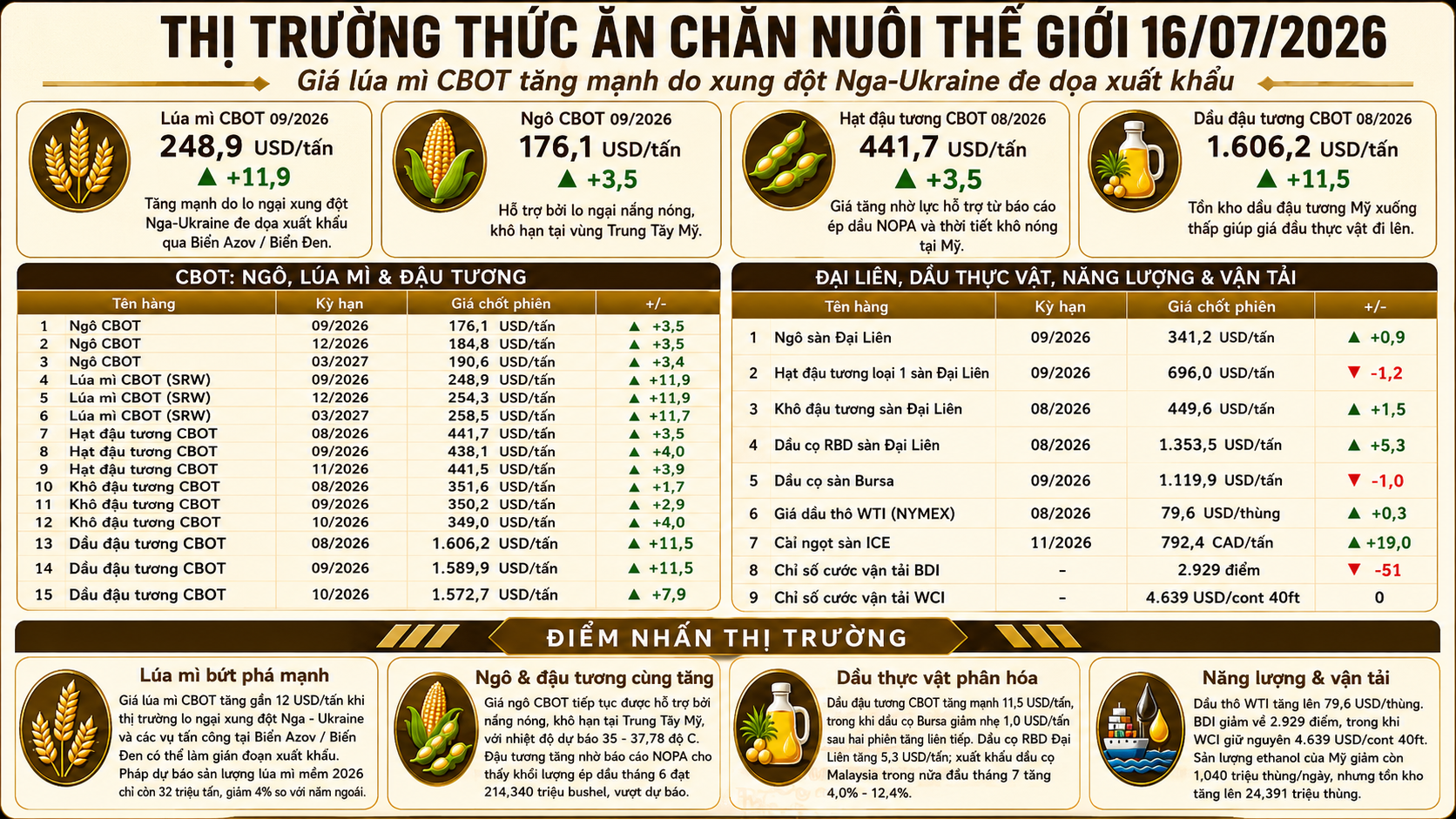
The global animal feed ingredient market recorded broad gains in the July 15 trading session. CBOT wheat was the strongest performer, with futures contracts increasing by USD 11.7–11.9 per tonne.
CBOT corn, soybeans, soybean meal and soybean oil also moved higher. Prices were supported by hot and dry weather in the U.S. Midwest, positive oilseed crushing data and concerns over grain export disruptions in the Black Sea region.
In other markets, Dalian RBD palm oil and WTI crude oil increased slightly, while Bursa palm oil declined. The Baltic Dry Index fell by 51 points, while the Drewry World Container Index remained unchanged.
2. CBOT wheat prices rise by nearly USD 12 per tonne
The September 2026 CBOT soft red winter wheat contract increased by USD 11.9 per tonne to USD 248.9 per tonne.
The December 2026 contract also gained USD 11.9 per tonne, reaching USD 254.3 per tonne. The March 2027 contract increased by USD 11.7 per tonne to USD 258.5 per tonne.
Wheat recorded the strongest gains of the session as the market became increasingly concerned about grain exports from Russia and Ukraine.
3. Russia-Ukraine conflict threatens wheat supplies
Wheat prices surged following additional attacks in the Azov Sea and Black Sea regions, which are important routes for Russian and Ukrainian grain exports.
Ukraine’s port of Odesa was attacked, while Kyiv’s unmanned naval forces were reported to have targeted a Russian oil tanker.
The market is concerned that the conflict could spread to other ports and transport routes, disrupting shipments of wheat, corn and other agricultural commodities from the Black Sea region.
Commodity funds held a large net-short position in CBOT wheat, meaning short-covering also contributed to the sharp price increase.
4. Wheat production outlook weakens in France and Kazakhstan
France forecast its 2026 soft wheat production at approximately 32 million tonnes, down 4% from the previous year and around 2% below the five-year average.
The U.S. Department of Agriculture projected Kazakhstan’s 2026/2027 wheat production at 15 million tonnes, significantly below the previous season’s 19.33 million tonnes.
Although Kazakhstan’s harvested area is expected to increase by around 1.2 million hectares, yields could fall from 1.69 tonnes per hectare to 1.24 tonnes per hectare.
Weaker production prospects in key exporting regions continued to support global wheat prices.
5. CBOT corn prices rise on hot and dry U.S. weather
The September 2026 CBOT corn contract increased by USD 3.5 per tonne to USD 176.1 per tonne.
The December 2026 contract rose to USD 184.8 per tonne, while the March 2027 contract gained USD 3.4 per tonne to USD 190.6 per tonne.
Corn prices were supported by forecasts for continued hot and dry weather across the U.S. Midwest. Temperatures in some areas were expected to reach 35–37.78°C, raising concerns over crop yields.
Adverse weather during a critical crop development period could directly affect the U.S. supply outlook.
6. CBOT soybean prices continue to rise
The August 2026 CBOT soybean contract increased by USD 3.5 per tonne to USD 441.7 per tonne.
The September 2026 contract gained USD 4.0 per tonne to USD 438.1 per tonne. The November 2026 contract closed at USD 441.5 per tonne, up USD 3.9 per tonne.
Soybean prices were supported by hot and dry U.S. weather concerns and positive crushing data from the National Oilseed Processors Association.
7. NOPA crushing data supports soybean prices
NOPA members crushed approximately 214.340 million bushels of soybeans in June, exceeding the expectations of many analysts.
The strong crushing volume indicated that U.S. soybean processing demand remained positive, supporting soybean and soybean oil prices.
NOPA also reported that U.S. soybean oil stocks declined more than expected in June to approximately 1.501 billion pounds, the lowest level in eight months.
Meanwhile, ANEC raised its forecast for Brazil’s July soybean exports by 1.5 million tonnes, from 12.25 million tonnes to 13.76 million tonnes.
8. CBOT soybean meal prices increase
The August 2026 CBOT soybean meal contract increased by USD 1.7 per tonne to USD 351.6 per tonne.
The September 2026 contract rose by USD 2.9 per tonne to USD 350.2 per tonne. The October 2026 contract gained USD 4.0 per tonne, reaching USD 349.0 per tonne.
Soybean meal followed the broader soybean market higher, supported by positive processing demand. However, new South American supplies may limit further gains.
9. Soybean oil rises on lower inventories
The August 2026 CBOT soybean oil contract increased by USD 11.5 per tonne to USD 1,606.2 per tonne.
The September 2026 contract also gained USD 11.5 per tonne to USD 1,589.9 per tonne. The October 2026 contract rose by USD 7.9 per tonne to USD 1,572.7 per tonne.
U.S. soybean oil stocks falling to an eight-month low provided significant support to the market.
High crude oil prices also strengthened demand expectations for vegetable oils used in biofuel production.
10. Dalian palm oil rises while Bursa palm oil declines
The August 2026 Dalian RBD palm oil contract increased by USD 5.3 per tonne to USD 1,353.5 per tonne.
In contrast, the September 2026 Bursa palm oil contract fell by USD 1.0 per tonne to USD 1,119.9 per tonne, following gains in the previous two sessions.
Malaysia’s palm oil exports between July 1 and July 15 were estimated to have increased by around 4.0–12.4% from the comparable period of the previous month.
Despite improved exports, the Bursa market lacked sufficient new information to extend its rally.
11. WTI crude oil rises to USD 79.6 per barrel
The August 2026 WTI crude oil contract increased by USD 0.3 per barrel to USD 79.6 per barrel.
High energy prices continued to support vegetable oils, particularly soybean oil used in biofuel production.
However, U.S. ethanol production in the week ending July 10 declined to 1.040 million barrels per day, down 53,000 barrels per day from the previous week.
U.S. ethanol stocks increased by 463,000 barrels to 24.391 million barrels.
12. Dalian commodity prices show mixed movements
The September 2026 Dalian corn contract increased by USD 0.9 per tonne to USD 341.2 per tonne.
Dalian Grade 1 soybeans declined by USD 1.2 per tonne to USD 696.0 per tonne, while soybean meal increased by USD 1.5 per tonne to USD 449.6 per tonne.
RBD palm oil rose to USD 1,353.5 per tonne, showing continued support for processed feed ingredients and vegetable oils in China.
13. ICE canola rises by CAD 19 per tonne
The November 2026 ICE canola contract closed at CAD 792.4 per tonne, up CAD 19.0 per tonne.
This was one of the strongest increases outside the CBOT wheat market.
The recovery in vegetable oil prices and demand for oilseed processing materials may continue to support the oilseed market in the near term.
14. Dry bulk freight declines while container rates remain unchanged
The Baltic Dry Index fell by 51 points to 2,929 points.
The decline indicated a correction in freight rates for dry bulk commodities such as grain, coal and iron ore.
The Drewry World Container Index remained unchanged at USD 4,639 per 40-foot container.
Although container rates did not rise further, they remained elevated and continued to pressure animal feed ingredient import costs.
15. Market outlook
CBOT wheat prices may remain highly volatile in the short term, depending on developments in the Russia–Ukraine conflict and grain transportation through the Black Sea and Azov Sea.
Corn and soybean prices will continue to respond to weather forecasts across the U.S. Midwest. Prolonged hot and dry conditions could provide additional support.
Soybean oil may remain firm due to low inventories, while palm oil prices will depend on Malaysia’s export and stock data.
Animal feed ingredient importers should closely monitor international commodity prices, energy markets, freight rates and geopolitical risks when planning purchases.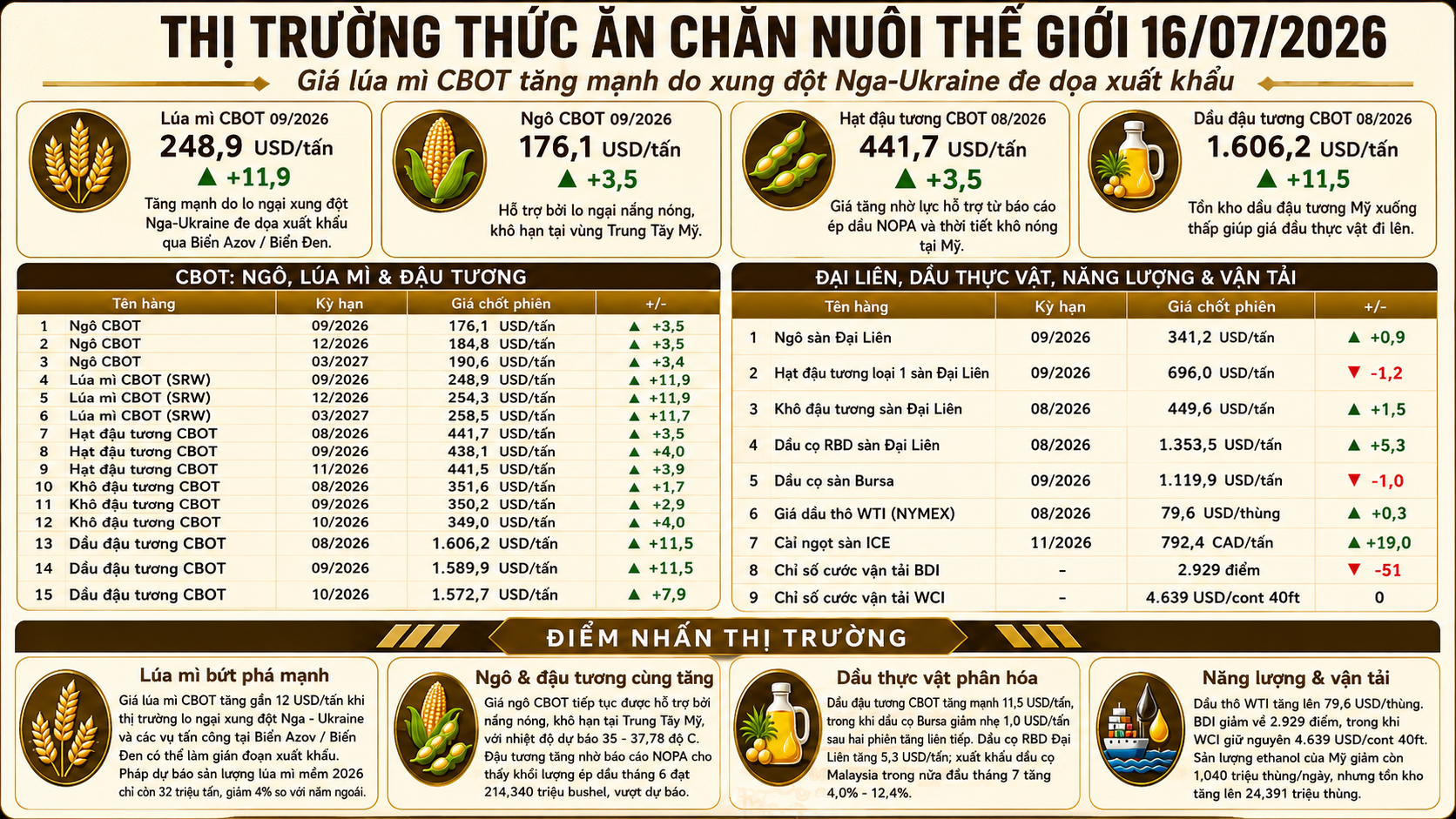
toc TABLE OF CONTENTS
recommend RECOMMENDED NEWS
Global Feed Market Report (Aug 6, 2026): CBOT Corn and Soybeans Ease on Beneficial US Weather
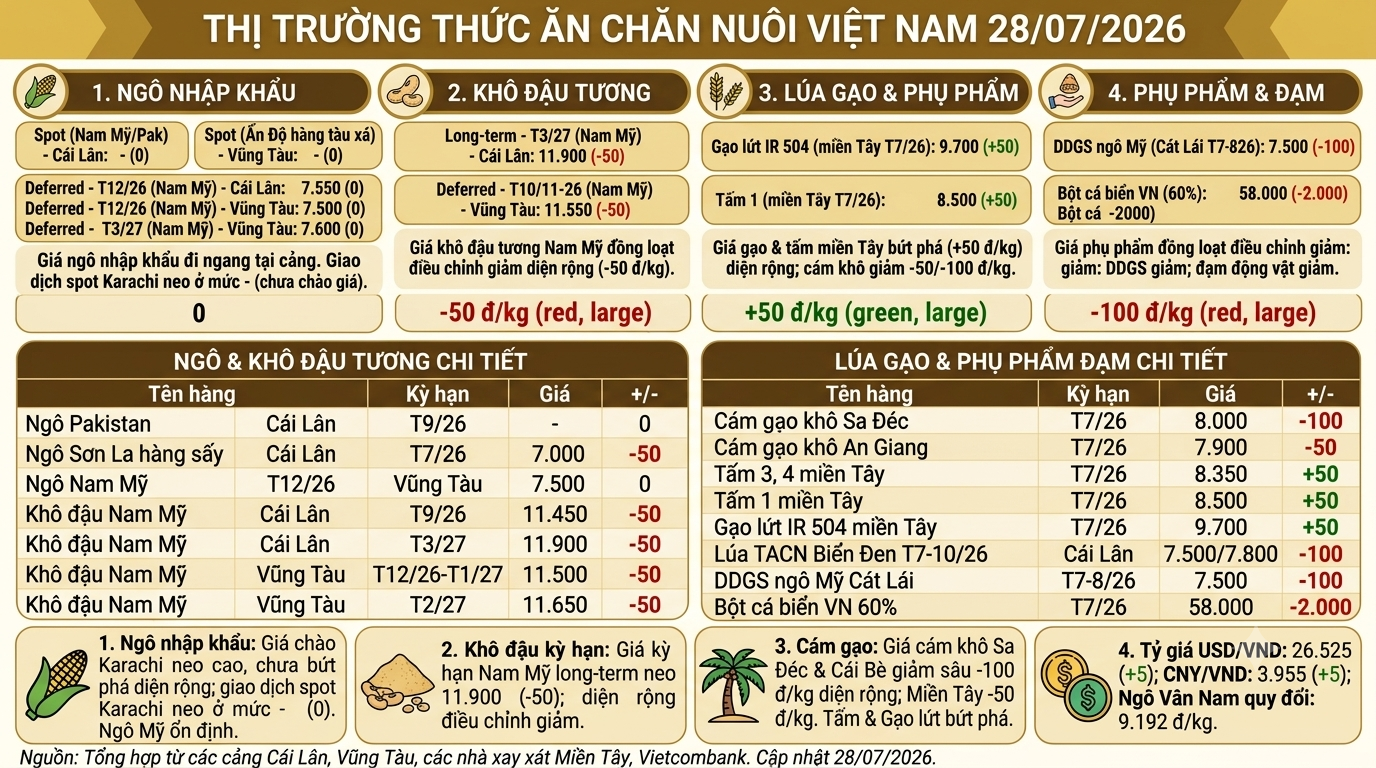
VIETNAM ANIMAL FEED MARKET ANALYSIS (JULY 29, 2026): ABUNDANT IMPORT SUPPLY VS. LOCAL BYPRODUCT ADJUSTMENTS