English
 Việt Nam
 Japan (日本語)
 Korea (한국어)
 China (中文)
 France (Français)
 Spain (Español)
 Germany (Deutsch)
 Russia (Русский)
 Saudi Arabia (العربية)
 Italy (Italiano)
 Thailand (ไทย)
 Laos (ລາວ)
 Cambodia (ភាសាខ្មែរ)
 Myanmar (မြန်မာ)
 Indonesia (Bahasa)
 Malaysia (Melayu)
 Philippines (Filipino)
 India (हिन्दी)
 Pakistan (اردو)
 Bangladesh (বাংলা)
 Portugal (Português)
 Netherlands (Nederlands)
 Poland (Polski)
 Turkey (Türkçe)
 Sweden (Svenska)
 Norway (Norsk)
 Denmark (Dansk)
 Finland (Suomi)
 Greece (Ελληνικά)
 Israel (עברית)
 Hungary (Magyar)
 Czech (Čeština)
 Slovakia (Slovenčina)
 Romania (Română)
 Ukraine (Українська)
 Bulgaria (Български)
 Croatia (Hrvatski)
 Serbia (Српски)
 Iran (فارسی)
 Kenya (Swahili)
 South Africa (Afrikaans)
 Iceland (Íslenska)
 Ireland (Gaeilge)
 Estonia (Eesti)
 Latvia (Latviešu)
 Lithuania (Lietuvių)
 Azerbaijan (Azərbaycan)
 Ethiopia (Amharic)
 Armenia (Հայերեն)
 Belarus (Беларуская)
 Bosnia (Bosanski)
 Esperanto
 Georgia (ქართული)
 Nigeria (Hausa)
 Kazakhstan (Қазақ тілі)
 Kyrgyzstan (Кыргызча)
 Macedonia (Македонски)
 Madagascar (Malagasy)
 Mongolia (Монгол хэл)
 Nepal (नेपाली)
 Sri Lanka (Sinhala)
 Slovenia (Slovenščina)
 Somalia (Soomaali)
 Tajikistan (Тоҷикӣ)
 Uzbekistan (Oʻzbekcha)
 Albania (Shqip)
 Malta (Malti)
 Latin
Latin
 Luxembourg (Lëtzebuergesch)
 New Zealand (Māori)
 Haiti (Kreyòl Ayisyen)
 Afghanistan (Pashto)
 Kurdish (Kurdî)
 Malawi (Chichewa)
 Samoan (Gagana Sāmoa)
 Zimbabwe (Shona)
 Lesotho (Sesotho)
Global Animal Feed Market on July 10, 2026: CBOT Corn and Soybean Prices Continue to Decline
CBOT corn and soybean prices continued to fall in the July 9 trading session due to favorable weather in the U.S. Midwest and weaker-than-expected export sales. Meanwhile, wheat and soybean meal prices increased, while global freight rates continued to rise.
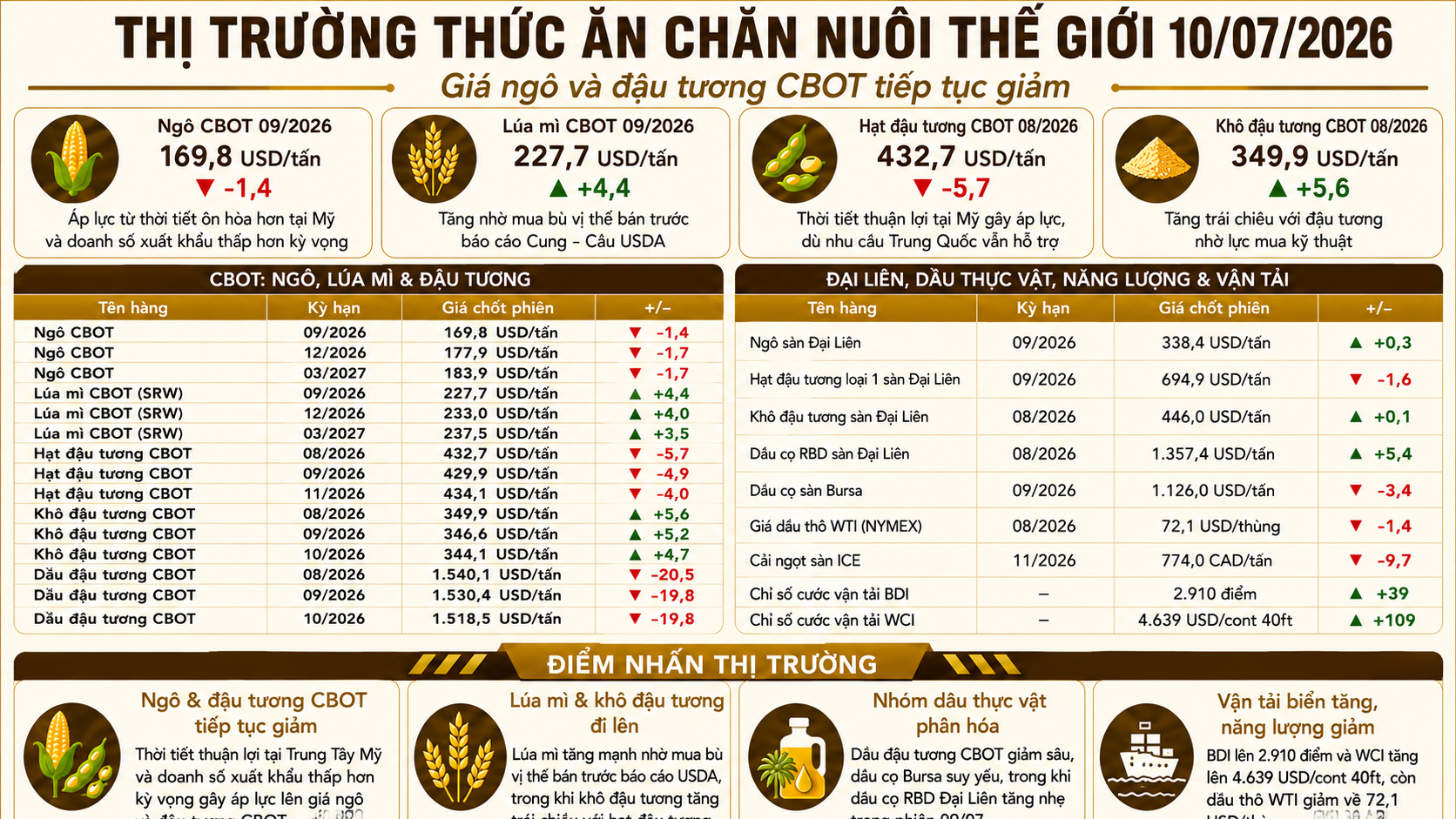
Global animal feed commodity market overview
The global animal feed ingredient market showed mixed movements in the July 9 trading session. CBOT corn and soybean prices continued to decline, while wheat and soybean meal prices recorded notable gains.
Favorable weather conditions in the U.S. Midwest reduced concerns over crop development, placing downward pressure on corn and soybean prices. In contrast, wheat prices rose as investors adjusted their positions ahead of the latest USDA supply and demand report.
CBOT corn prices decline
CBOT corn futures continued to weaken due to improved weather conditions across major producing areas in the United States. Cooler temperatures and better rainfall prospects supported crop development during the critical pollination period.
The September 2026 corn contract closed at USD 169.8 per tonne, down USD 1.4 per tonne. The December 2026 contract fell by USD 1.7 per tonne to USD 177.9 per tonne.
The market was also pressured by weaker U.S. weekly export sales. Old-crop corn sales reached approximately 565,800 tonnes, while new-crop sales totaled around 401,700 tonnes, both below market expectations.
CBOT wheat prices rebound
CBOT wheat prices increased sharply as traders covered short positions ahead of the USDA World Agricultural Supply and Demand Estimates report.
The September 2026 soft red winter wheat contract rose by USD 4.4 per tonne to USD 227.7 per tonne. The December 2026 contract gained USD 4.0 per tonne, reaching USD 233.0 per tonne.
Market expectations that the USDA could lower its forecast for U.S. wheat ending stocks also supported prices.
Soybean prices fall while soybean meal rises
CBOT soybean prices declined due to favorable U.S. weather and lower-than-expected export sales. The August 2026 soybean contract fell by USD 5.7 per tonne to USD 432.7 per tonne.
However, Chinese demand helped limit the decline. The USDA confirmed additional U.S. soybean sales to China, including a new order of 136,000 tonnes.
Soybean meal moved in the opposite direction. The August 2026 soybean meal contract increased by USD 5.6 per tonne to USD 349.9 per tonne, supported by technical buying and stronger demand for protein feed ingredients.
Soybean oil and palm oil prices weaken
CBOT soybean oil prices fell sharply, following lower crude oil prices and improved U.S. crop prospects. The August 2026 soybean oil contract declined by USD 20.5 per tonne to USD 1,540.1 per tonne.
Malaysian palm oil futures also edged lower. The September 2026 Bursa contract fell by USD 3.4 per tonne to USD 1,126.0 per tonne.
The market remained cautious about Indonesia’s B50 biodiesel program. The policy could increase domestic palm oil demand, although detailed implementation quotas have not yet been announced.
Dalian commodity market shows mixed movements
On the Dalian Commodity Exchange, corn futures edged up to USD 338.4 per tonne, while Grade 1 soybean prices declined to USD 694.9 per tonne.
Dalian soybean meal increased slightly to USD 446.0 per tonne. Soybean oil prices fell, while palm oil gained USD 5.4 per tonne.
Freight rates continue to rise
Global freight costs continued to increase. The Baltic Dry Index rose by 39 points to 2,910 points, indicating stronger demand for dry bulk shipping.
The Drewry World Container Index increased by USD 109 to USD 4,639 per 40-foot container.
Higher shipping costs may increase import expenses for corn, soybean meal, wheat and other animal feed ingredients in the coming period.
Market outlook
In the short term, CBOT corn and soybean prices may remain under pressure if favorable U.S. weather conditions continue. Wheat and soybean meal prices could remain volatile due to USDA supply forecasts and speculative position adjustments.
For animal feed producers and importers, rising freight rates remain a key risk because higher transportation costs may offset part of the benefit from lower international grain prices.
toc TABLE OF CONTENTS
recommend RECOMMENDED NEWS
Global Feed Market Report (Aug 6, 2026): CBOT Corn and Soybeans Ease on Beneficial US Weather
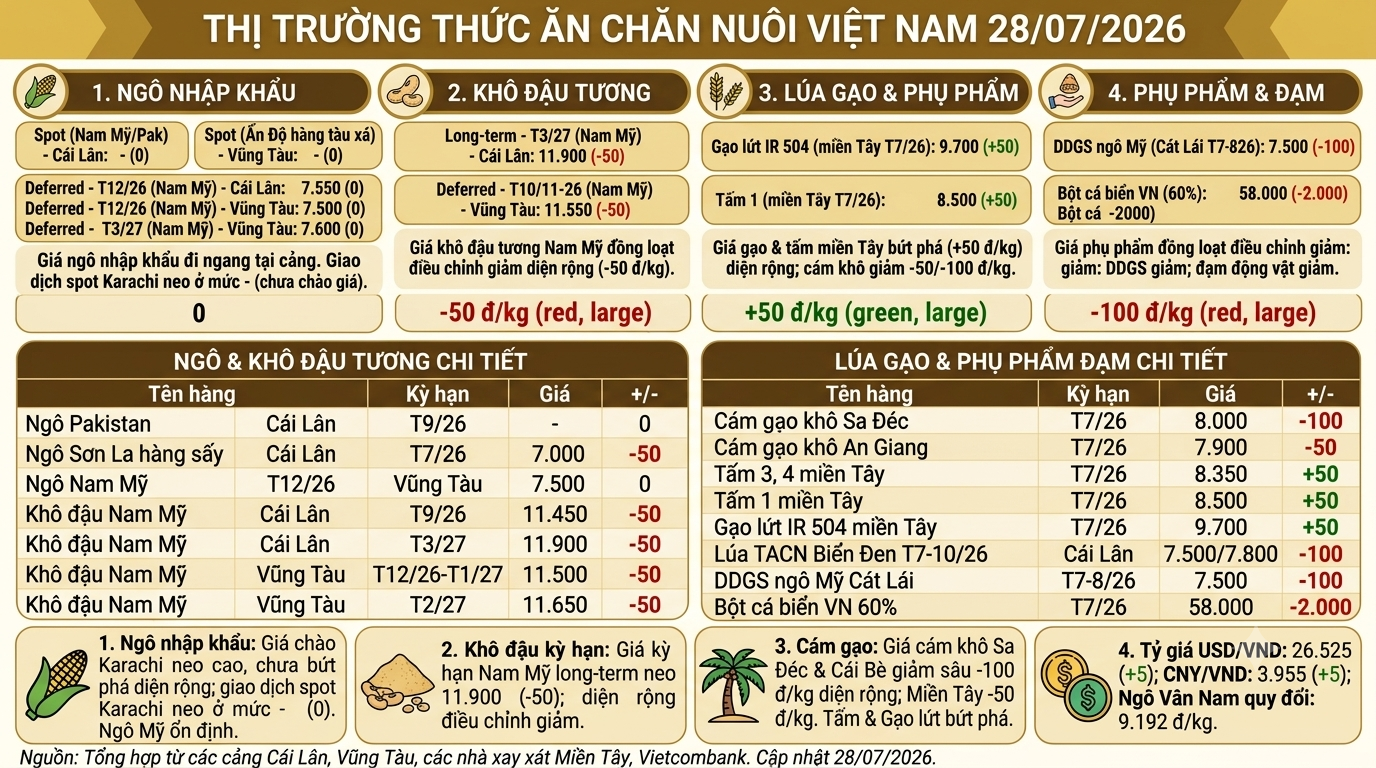
VIETNAM ANIMAL FEED MARKET ANALYSIS (JULY 29, 2026): ABUNDANT IMPORT SUPPLY VS. LOCAL BYPRODUCT ADJUSTMENTS